More than a decade ago, Anna Peña discovered she could help save someone in need of a blood stem cell transplant even though she was ineligible to donate.
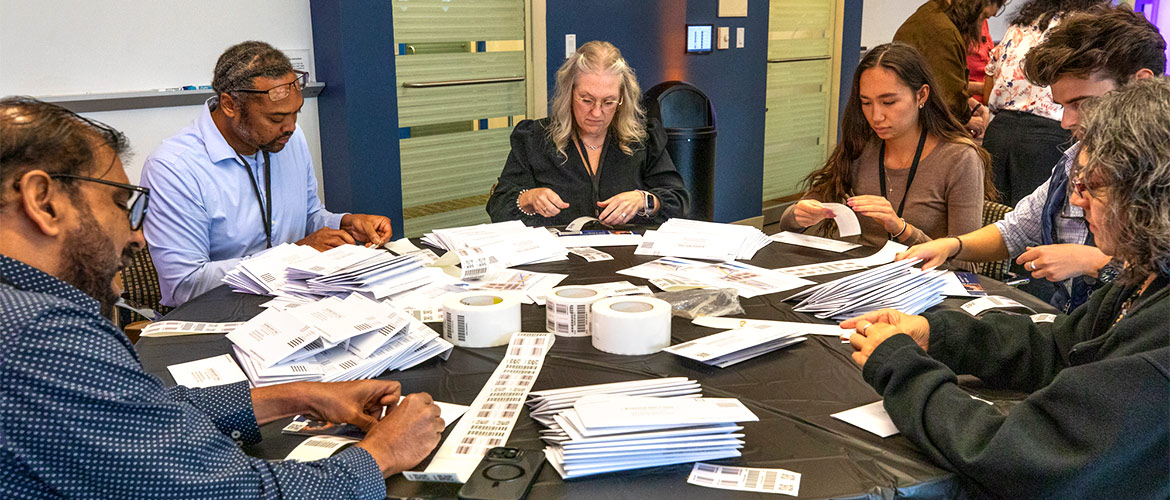
Hired in 2014 as a fully remote employee of Health Care Service Corporation in Texas, Peña joined an internal business resource group to connect with colleagues. As part of an annual volunteerism project, group members gathered throughout Texas to package cheek swab kits that NMDP — the National Marrow Donor Program — uses to collect samples from potential blood stem cell donors to add to its registry.
The registry matches donors with people diagnosed with blood cancer and diseases, including leukemia, lymphoma, aplastic anemia and sickle cell, in need of stem cell transplants.
“This was a great way to get involved with my coworkers and help people,” says Peña, a quality management specialist, who now helps organize the group’s annual NMDP volunteer project around the country. “I am so committed to it.”
In 2025, the group packed an estimated 29,800 swab kits, which were used to add nearly 54,000 potential donors to the registry. Thirteen people were identified as matches and became donors.
Peña’s commitment and connection to NMDP inspired other HCSC employees to hold more cheek swab volunteer events. In April, employees across the country packed more than 22,000 swab kits.
“These efforts reflect and represent our purpose in action and the meaningful difference employees can make when we come together to support healthier, stronger communities,” says Clarita Santos, HCSC vice president of community solutions.
Samuel Hillhouse, an NMDP manager of member recruitment and member, donor and product operations, says volunteer events like those held at HCSC help him and his staff focus on community engagement and education efforts. They have plenty of swab kits to distribute at donor recruitment events held throughout the country because of that volunteerism, he says.
“It is simple to create one swab test kit,” says Hillhouse, a 10-year NMDP veteran. “But if it wasn’t for the volunteers who are willing to do that, the amount of hours it would take for me and my team to do it would take away from the work we do in the community. It speaks volumes about the type of employees HCSC hires. The impact they make is tangible.”
While some offices hold in-person kit preparation events, Pena sends boxes of kits to the homes of remote employees. She holds virtual meetings to teach them how to prepare the kits and return them to NMDP. Employees often request more boxes so they can involve their families.
“I think a lot of people just want to help,” says Peña, adding that the registry needs a more racially and ethnically diverse donor pool. “This is something I can do for my community. Since I can’t be a donor, this is something that really speaks to me.”
An unexpected match
In 2007, Diana Reynoso, a senior manager for HCSC in Texas, joined the NMDP registry to see whether she could be a potential donor for someone. Fourteen years later, she matched a 6-year-old boy in Spain.
Typically, NMDP limits blood stem cell donation at age 40, and Reynoso technically no longer met the criteria for donation. But NMDP told her it would make an exception if she still would be willing to help.
“How could I say no?” asks Reynoso, whose family is of Spanish ancestry. Also, the youngest of her four sons was then about the same age as the boy in need.
After a lengthy qualification process, Reynoso was flown to a Florida NMDP center to donate. It was Nov. 8, 2021, her father’s birthday, a day of immense importance to her since his 2025 death.
“He was happy I was able to do that for someone,” says Reynoso, who has encouraged her sons to join the registry. “I feel like if I could do it, anyone could.”
Describing herself as a servant leader, Reynoso still participates in annual swab kit volunteerism events. She knows how important it is to fill the registry with potential donors, like she was.
“I hope that it helps show that anyone can help in some way,” Reynoso says.